
How Artificial Intelligence can support urban management


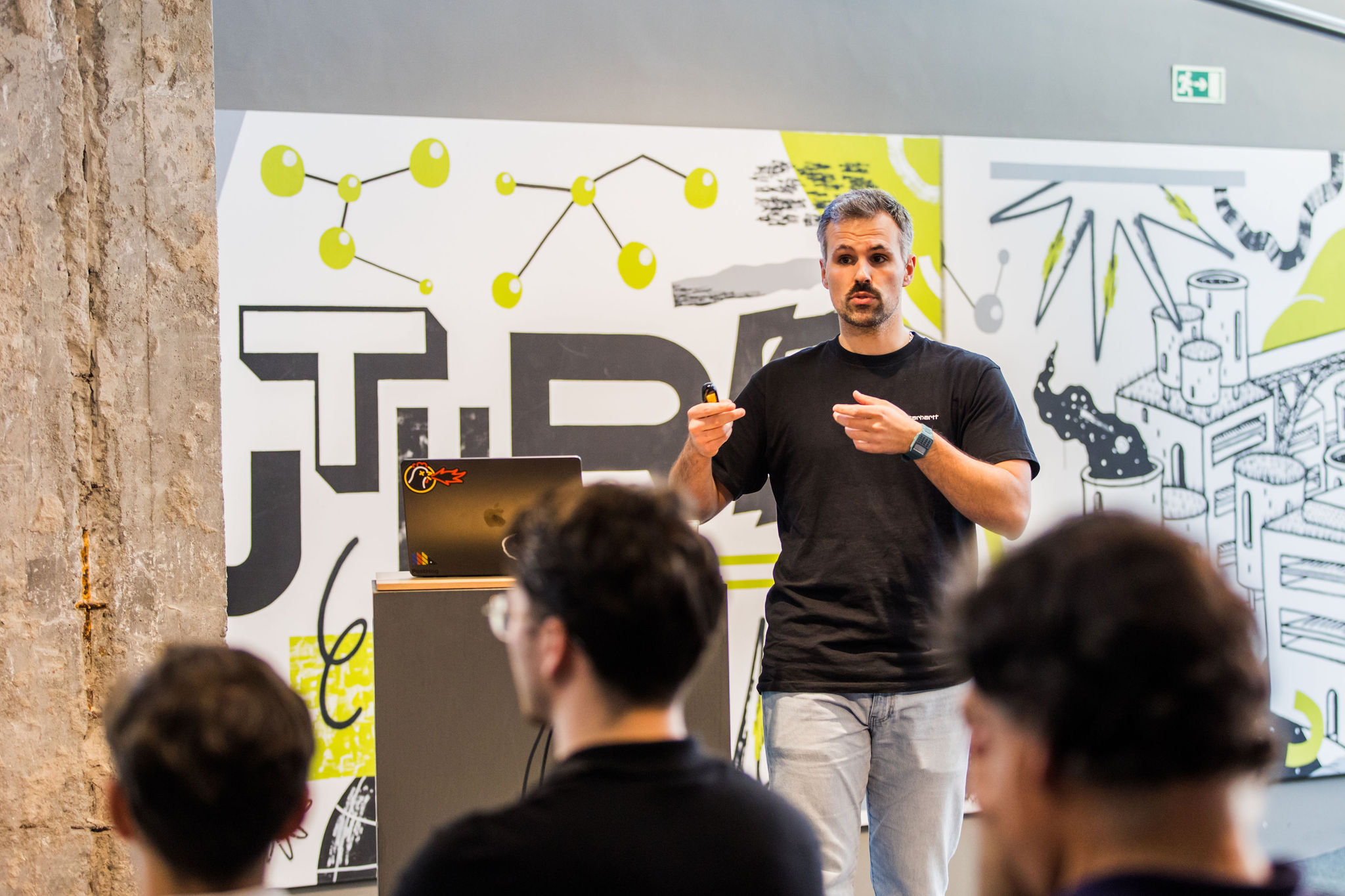


City Café promotes debate on the role of AI in the public sector, exploring its ethical, operational, and institutional challenges.
On 20 May, the Porto Innovation Hub hosted a new session on the Challenges in a More Digital Porto cycle, focusing on the use of Artificial Intelligence (AI) to tackle the growing challenges facing cities. The activity invited professionals from the public and private sectors to an open conversation, with the aim of showing how the city of Porto has combined innovation and technology to respond to the challenges of the future, delving into topics such as artificial intelligence, civic participation and cultural and digital transformation.
The guest speaker was Guilherme Mota, a software engineer and AI enthusiast, who brought practical examples, accessible tools and an educational approach to how this technology can be integrated into routine urban services.
“For a long time, it was thought that AI was magic. But AI is maths. It’s statistics and it requires responsibility,” said the guest.
AI applied to the city: concrete cases and useful models.
The session began by clarifying the difference between traditional AI, based on fixed rules, and generative AI, capable of creating new content based on large volumes of data. Guilherme Mota summarised:
“Traditional AI was like a rules technician. Generative AI is a super committed trainee – it responds to everything, even when it doesn’t know it well.“
Practical examples included uses of AI in:
- Automatically generating responses to requests addressed to the City Council
- Writing administrative reports
- Supporting interaction with citizens
- Optimising back-office tasks
Tools such as ChatGPT, Claude, Perplexity, Gamma.app or Eleven Labs were also mentioned, all of which have the potential for controlled and strategic use in a municipal environment.
Ethical challenges and the importance of human validation
Alongside the opportunities, the speaker warned of the main risks associated with the use of Artificial Intelligence in urban and administrative contexts: hallucinations (wrong answers presented with apparent confidence), the ecological footprint resulting from the intensive use of servers and data centres, the reproduction of social prejudices present in training data, and issues of privacy and information security.
“AI is only dangerous if we don’t know what we’re doing with it. If we don’t review what it generates, we risk answering a citizen with an error… and believing that it’s right,” argued the expert.
Responsible experimentation: test, validate and adopt
At the end of the session, the speaker shared some essential guidelines for those who want to adopt Artificial Intelligence tools in the municipal context safely and effectively:
- Test tools with caution and clear objectives: Before integrating new technologies into everyday life, it’s important to understand them well, explore their functionalities and realise where they can really add value.
- Keep good usage models: As you test tools, it’s useful to create a library of successful examples – effective prompts, practical cases, functional approaches – that serve as a basis for future use.
- Strengthen the digital literacy of technical and administrative teams: The introduction of AI into work routines must be accompanied by training and capacity building, ensuring that everyone understands the fundamentals, limits and implications of the technology.
- Think of AI as a support, not a substitute for public decision-making: Artificial intelligence should be seen as a complementary tool – useful for increasing the efficiency and quality of public service, but always subordinate to human judgement and institutional responsibility.
“AI is not a destination. It’s a tool. It’s up to us to decide how – and for what – we use it,” concluded the speaker.
With this session – the fifth and last of the Challenges in a More Digital Porto cycle – the Porto Innovation Hub concludes an activity that has promoted informed debate on the use of emerging technologies in the urban context. Throughout the sessions, more than 130 participants from the public and private sectors contributed to a transversal reflection on digital innovation, artificial intelligence, civic participation and cultural transformation. This day reinforces PIH’s role as a space for strategic dialogue, internal training and commitment to a smarter, more responsible city.