
More Clean Energy: the path to a more sustainable future
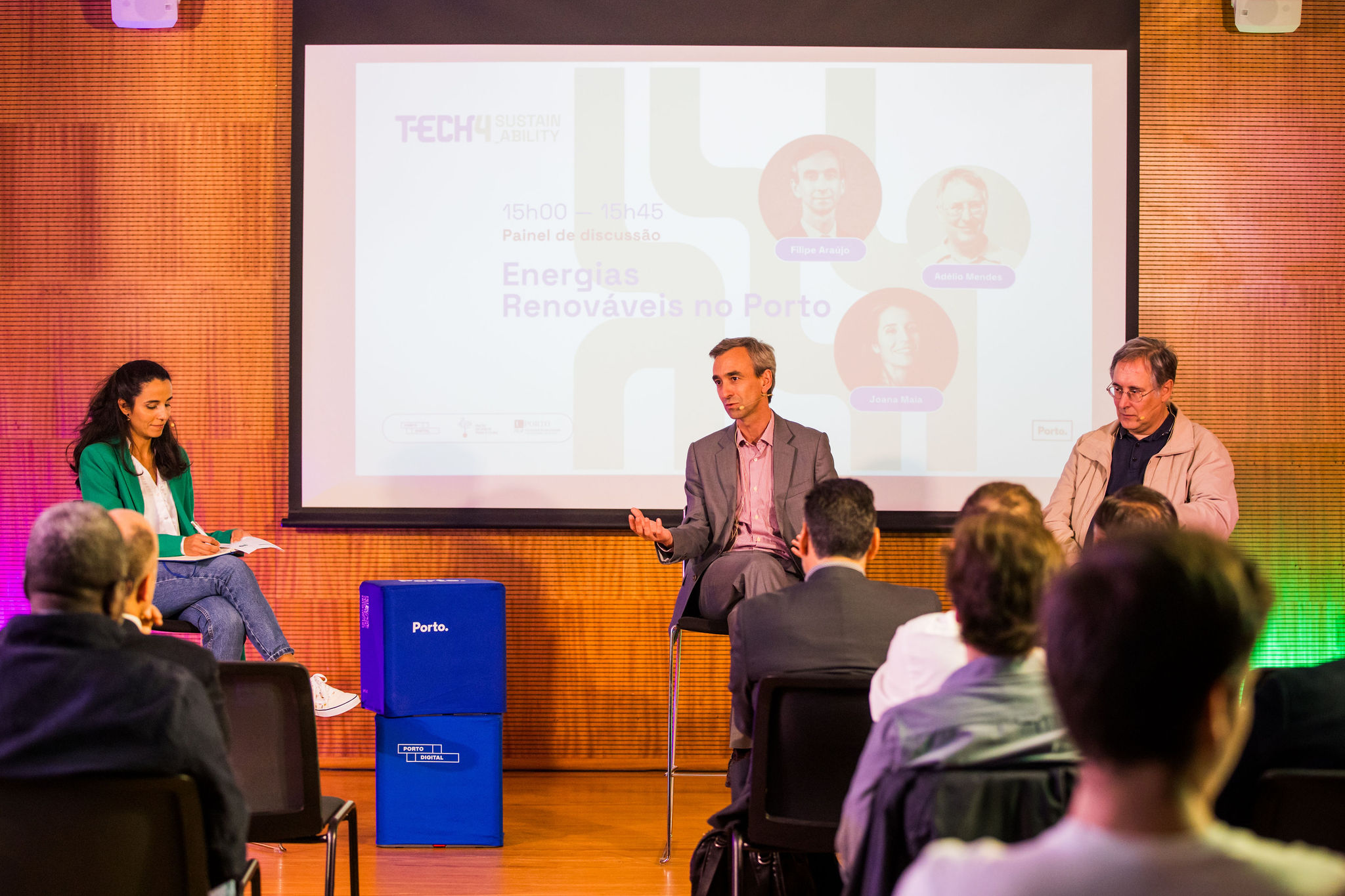
This was the theme of the second TECH4 Sustainability conference, held in October at UPTEC.
The energy transition is an unavoidable topic today, particularly in the context of climate change and the urgent need to reduce the carbon footprint. This issue goes far beyond simply cutting emissions; it requires the swift adoption of practices that support the preservation and conservation of natural resources.
On 25 October, Filipe Araújo, Vice-President of Porto City Council, empahized that the Municipality is “strongly committed to changing the paradigm of the energy transition.”
In a speech focused on energy transformation projects, the Deputy Mayor also noted that the Municipality actively encourages the public to install photovoltaic panels.
“We are offering a property tax (IMI) reduction of €500 per kilowatt (kW) installed. And we have around €8 million available to fund these investments in the coming years,” he concluded.
But what exactly does ‘More Clean Energy’ mean?
Clean energy refers to various forms of energy production that have a lower environmental impact compared to traditional sources such as fossil fuels (coal, oil, and natural gas). Solar, wind, hydroelectric, geothermal, and biomass energy are examples of cleaner energy sources, as they come from renewable resources.
In this context, the city of Porto has been investing in energy solutions that not only reduce greenhouse gas emissions but also promote energy self-sufficiency and technological innovation. At the heart of the discussion is the use of clean energy solutions, which offer vast potential and are transforming the way the city and its infrastructure generate and consume energy.
Two key projects, 112CO2 and biogas production at the Freixo Wastewater Treatment Plant (ETAR), were highlighted during the TECH4 Sustainability conference. These initiatives represent Porto’s commitment to the energy transition and the reduction of carbon emissions.
The 112CO2 project, led by the Faculty of Engineering at the University of Porto (FEUP), uses an innovative technology to convert methane into hydrogen and carbon, without CO₂ emissions. This provides a more sustainable and cost-effective alternative for hydrogen production in industrial and mobile applications.
“This is the only and probably the best technology currently available on the market because it enables hydrogen production at the lowest cost. Therefore, its use reduces dependence on fossil fuels and promotes a transition to more sustainable energy sources,” stated Adélio Mendes, Professor at the Department of Chemical Engineering at FEUP.
At the Freixo Wastewater Treatment Plant (ETAR), biogas is generated through wastewater treatment and is used for thermal energy production. Researchers are currently exploring new technologies to maximise its production and usage.
“The use of biogas has several advantages, both from an energy and environmental perspective. Firstly, it helps reduce greenhouse gas emissions. Additionally, biogas is a renewable fuel, meaning its use reduces dependence on fossil fuels and promotes a shift towards more sustainable energy sources,” explained Cecília Santos, Coordinator for Wastewater Treatment at Águas e Energia do Porto.
Porto’s path to Energy Transition
The city is making a concerted effort to invest in technologies that drive the energy transition, aiming for self-sufficiency and carbon neutrality. Moving away from traditional energy models to cleaner alternatives brings numerous benefits, including reduced greenhouse gas emissions, which play a crucial role in tackling climate change. Furthermore, renewable energy sources are a sustainable option as they use inexhaustible resources, diversify energy sources, and enhance energy security.
Porto City Council is also one of the founding members of the new Association of Renewable Energy Communities of Northern Portugal, a pioneering initiative aimed at fostering the creation of energy communities in the region. This association brings together local authorities, academic institutions, and other organisations to promote renewable energy production and self-sufficiency, strengthening collaboration between citizens, businesses, and public entities. Notable projects in Porto include CER do Futebol Clube do Porto and the CER do Mercado Abastecedor.
“The city of Porto has been consistently investing in decarbonisation while simultaneously reducing energy costs. There is a strong commitment to introducing photovoltaic panels, facilitating energy management, encouraging the creation of energy communities, and promoting biogas production,” noted Adélio Mendes, Professor at FEUP.
The future of Clean Energy
The conference also provided an opportunity to discuss a range of technological innovations, from marine energy to the development of energy communities in the city, in a conversation between experts José Luís Alexandre and Francisco Taveira Pinto, both from FEUP.
One of the featured projects was Se@ports, which focuses on harnessing wave energy to power port areas.
“This project is a case study where we aim to quantify the available resource in the port’s area of intervention while simultaneously developing technologies to harness these electricity sources,” summarised Francisco Taveira Pinto, Director of the Department of Civil Engineering at FEUP.
Another project, ‘Portos’, was also highlighted, aiming to integrate all renewable energy sources within port infrastructure.
“We are witnessing a new generation of cogeneration units that can use natural gas mixed with hydrogen or other types of renewable gases,” explained José Luís Alexandre, researcher at the Fluid and Energy Section of the Department of Mechanical Engineering at FEUP.
A model for the future
Conference participants had the chance to visit the renewable energy project implemented in Bairro da Agra do Amial, which consists of photovoltaic panels connected to a local energy production system developed as part of the Asprela+Sustainable project.
“This is the first and largest energy community in the country. We have already achieved an average self-sufficiency rate of 49% in May, June, and July. This translates into an overall real reduction of approximately 46%,” explained Diogo Borges, a collaborator at Agência de Energia do Porto.
The path ahead
The transition to cleaner energy sources is a global imperative that requires collective collaboration. Through shared responsibility, it is possible to build a more sustainable and resilient future, ensuring that future generations will benefit from a healthy planet.
“We must all take on a shared commitment to achieving a decarbonised city and contributing to a more sustainable ecosystem,” concluded Filipe Araújo.
TECH4 Sustainability is an activity promoted by Porto City Council, coordinated by Porto Digital and the Porto Carbon Neutrality Directorate—as part of the Porto Climate Pact—in partnership with the Faculty of Engineering of the University of Porto (FEUP). It aims to showcase innovation and technology in support of sustainability, demonstrating real-life applications within the city of Porto.
Find out more about the initiative here.