
Parque da Alameda de Cartes: new green infrastructure for Campanhã
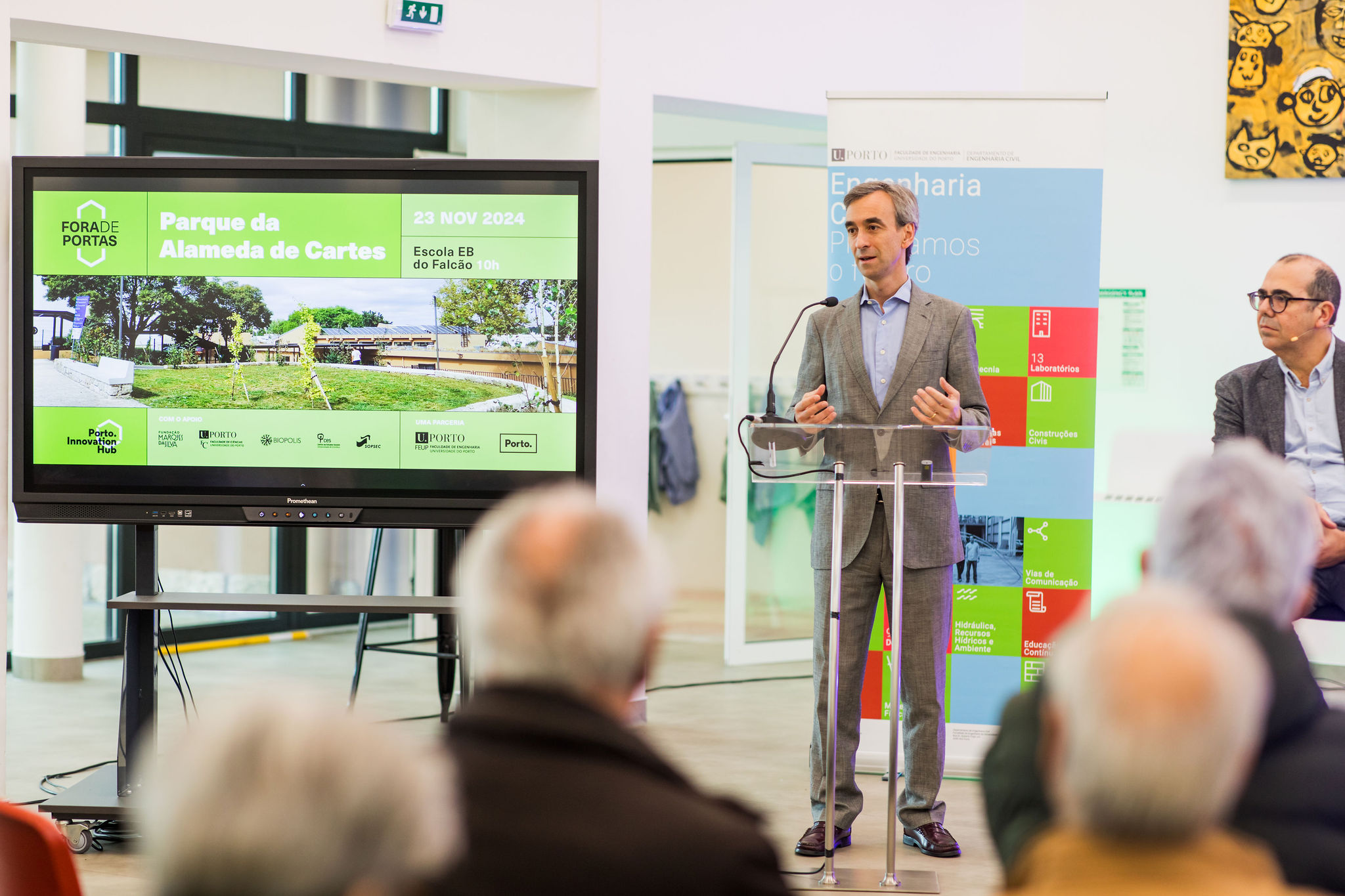
As part of the “Innovation Cycle Stepping Out – Civil Engineering on Display” activity, Falcão Primary School recently hosted the presentation of the intervention project at Parque da Alameda de Cartes.
“We are investing in the Campanhã area, and we are doing it well,” began Filipe Araújo, Vice-president of Porto City Council, at the opening of the session. “There has been extensive work carried out in this park, demonstrating that the city is working towards the future, providing a better quality of life for residents and visitors,” concluded the councillor.
This new green infrastructure in Campanhã includes over 1.5 kilometres of new pathways that promote sustainable mobility, allowing residents to move around on foot or by bicycle while connecting with nature and the urban landscape. Covering a total area of over four hectares, Alameda de Cartes Park represents a key piece of mobility infrastructure in Porto and is also a symbol of the transformation and revitalisation of urban space, fostering a more harmonious relationship between people and nature.
This project was developed through close collaboration between several institutions, including Porto City Council, Domus Social, the Faculty of Sciences at the University of Porto (FCUP), the Research Centre in Biodiversity and Genetic Resources (BIOPOLIS/CIBIO), the Centre for Social Studies at the University of Coimbra (CES), and the Civil Engineering Services Company (SOPSEC). Its potential was identified both through its socio-economic characteristics and through the priorities outlined in municipal planning instruments for action in this territory. Examples of this include the new Terminal Intermodal of Campanhã, the redevelopment of Matadouro Industrial do Porto, the refurbishment da Praça of Corujeira and the extension of Parque Oriental.
For José Miguel Lameiras, landscape architect at FCUP and one of the project’s coordinators, Campanhã holds great potential for transformation, even describing it as “one of the best areas in Porto.”
The design of Parque da Alameda de CartesA is proof of this potential, opening up an axis of urban revitalisation and creating a more sustainable area. One of the main objectives of the intervention was to establish new pedestrian connections between predominantly underutilised areas and multifunctional spaces, ensuring access to parks, schools, facilities, and services.
The “Green Corridor” of Campanhã
The Parque da Alameda de Cartes is also an example of investment in the creation of urban green corridors, promoting biodiversity and the sustainability of the urban landscape.
“This park was designed with Porto’s climate resilience in mind. One of the principles applied here was the creation of a green structure with around a thousand trees,” explained the architect.
To accelerate the growth of this green structure, a combination of fast-growing and slow-growing species was used, ensuring different landscape scenarios over the next 20 years. Two-thirds of the vegetation consists of native shrubs, while areas with higher social usage feature non-invasive exotic species. In the meadows, irrigated areas are alternated with dryland meadows on slopes, optimising water resources and creating ecological diversity that enhances the floral aesthetics, colours, and textures of the landscape.
Goreti Guedes, from SOPSEC, explained that the stormwater management system was developed in collaboration with landscape architects, starting with infiltration and retention in green areas, using natural basins formed by land modelling. When necessary, excess water is channelled into the infrastructure. She highlighted that the calculated retention volume ensures local water treatment, one of the project’s major goals.
Beyond sustainability, visual, sensory, and environmental impacts—such as those caused by the A43 motorway—were also considered, alongside safety improvements achieved by removing visual barriers to increase the depth of pathways.
Parque da Alameda de Cartes has become a new green corridor connecting several strategic points in the parish, including the Falcão, Cerco, and Lagarteiro neighbourhoods, as well as Horta da Oliveira, Campanhã Municipal Field, Falcão Primary School, Cartes Swimming Pool, and the Oriental Park of the City.
“We worked closely with local stakeholders to ensure that all needs were met,” highlighted Gonçalo Canto Moniz (University of Coimbra and CES).
“Innovation Cycle Stepping Out – Civil Engineering on Display” is an activity of Municipality of Porto, developed within the scope of the Porto Innovation Hub, in close collaboration with the Civil Engineering Department of the Faculty of Engineering at the University of Porto.
The next session of this initiative will take place on 18 January 2025 and will focus on the Mosteiro de Leça do Balio, Fundação Livraria Lello. Participation in the sessions is free, subject to prior registration, and limited to the event’s capacity. Registration will soon be available here.