
“Innovation Stepping Out” takes us on a journey through the renovation of the Mosteiro de Leça do Balio
The walls stand tall and are imposing, and the stone defines the monument’s character. Upon entering the space, one experiences a welcoming atmosphere that captivates from the very first moment. As you cross the entrance, the desire to explore every corner of the Mosteiro de Leça do Balio arises—now also the headquarters of the Fundação Livraria Lello.
That is exactly what happened on 18 January, when the monastery opened its doors for another session of “Innovation Cycle Stepping Out – Civil Engineering on Display”. The event provided an up-close look at the rehabilitation process of this national monument, which has roots dating back to the Roman era.
The design team present at the session, consiting of Jorge Nunes da Silva (GOP Office) and Rita Amaral (representing Álvaro Siza Vieira), demonstrated the various phases of the project and outlined the goals set by the project owner to preserve the identity of the Mosteiro de Leça do Balio while introducing new functionalities.
“This building has undergone many interventions over time, in different periods, and our approach was to try to preserve the existing structural systems to ensure that the foundation remained intact. You can see a mixture of various elements, but our main concern was to guarantee that the structure could withstand the new interventions,” explained Jorge Nunes da Silva.
Renovation of the Casa Mosteiro
The renovation project for the Casa Mosteiro aimed to change its function—from the former residence of Ezequiel de Campos (a 19th-century engineer, professor, economist, writer, MP, and minister)—into a space dedicated to cultural, artistic, architectural, and landscape diversity. This hub now serves as a multifunctional centre, open to the community and connected to pilgrims.
Rita Amaral explained: “When Architect Siza visited the site, he was particularly intrigued by the overlapping historical periods visible in the building. From the very beginning , the idea was to embrace and showcase these layers.”
As part of the intervention, elements of poor quality—both structural and decorative—were demolished to ensure the spatial and structural integrity of the house. Doors, windows, floors, and wooden structures were restored, with granite being the predominant material. The built complex forms a U-shaped courtyard, allowing for a structured flow of visitors through the site, connecting the garden and the chapel.
“Architect Siza visited many times, and the project was only truly finished at the very end because we kept making changes, adding elements, and refining details,” revealed Rita Amaral.
The expansion of the Mosteiro de Leça do Balio
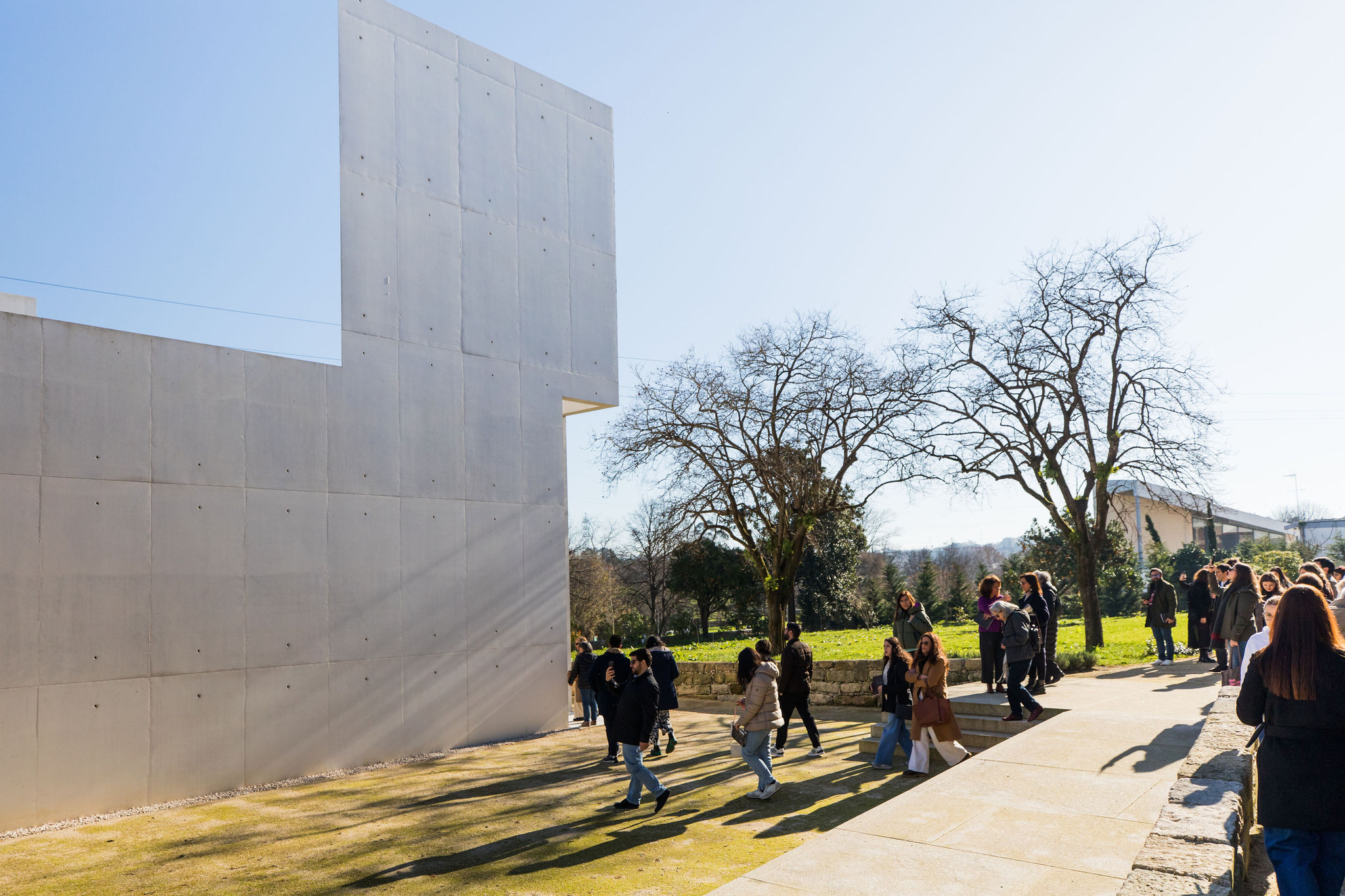
The new structure, covering 399 square metres, is located outside the monastery’s protected area and was designed as a landmark to support pilgrims. The structure consists of four concrete walls, two imposing towers—measuring 12 and 14 metres—and a central sculpture that reinforces the historical significance of the Mosteiro de Leça do Balio.
“This piece was one of the client’s first commissions. It is an open sculpture, connected to the pilgrim’s journey. Although it is not a religious space, its purpose is to offer a moment for reflection, rest, and introspection,” explained Rita Amaral.
The main building consists of two symmetrical angular volumes designed to create light wells. Between them is a sheltered entrance, with additional doors positioned at the corners for functional access. Within the courtyard, Siza Vieira conceived a 1.8-metre-tall concrete sculpture, which he named Wayfarer.
“We were fortunate to work with Architect Siza. From the very first discussions, we had clear objectives. Working in this way is straightforward, and this was a truly rewarding project. No one ‘put a spoke in the wheel’, and that’s the only reason we were able to achieve this result,” concluded Jorge Nunes da Silva during the presentation.
At the end of the session, over 50 participants accompanied the design team on a technical visit, observing in detail all the aspects discussed during the event.
Rita Marques, President of the Fundação Livraria Lello, was also present and stated: “I am very grateful to be able to host this event, and I congratulate the Porto Innovation Hub and the Civil Engineering Department of FEUP for organising and delivering this initiative. One of the Foundation’s goals is to encourage reading and discussion so that we become freer and more capable individuals, better equipped to understand the world.” Today, the Mosteiro de Leça do Balio serves as the headquarters of the Fundação Livraria Lello, bridging the past and the future.
The next session of this initiative will take place on 15 March, focusing on the Nova Sede da Liga Portuguesa de Futebol Profissional, also known as Arena Liga Portugal. Participation in the sessions is free, subject to prior registration, and limited to the venue’s capacity.
Registration will be available soon.